


Basics Of Forex Trading For Beginners
November 03, 2025Basics Of Forex Trading For Beginners
If you’ve ever traveled to another country and exchanged your home currency for local cash, you’ve already participated in the Forex (foreign exchange) market.
But there’s a big difference between trading a few dollars for a vacation and actively trading currencies for profit. The Forex market is the largest and most liquid financial market in the world, with over $7 trillion traded every single day.
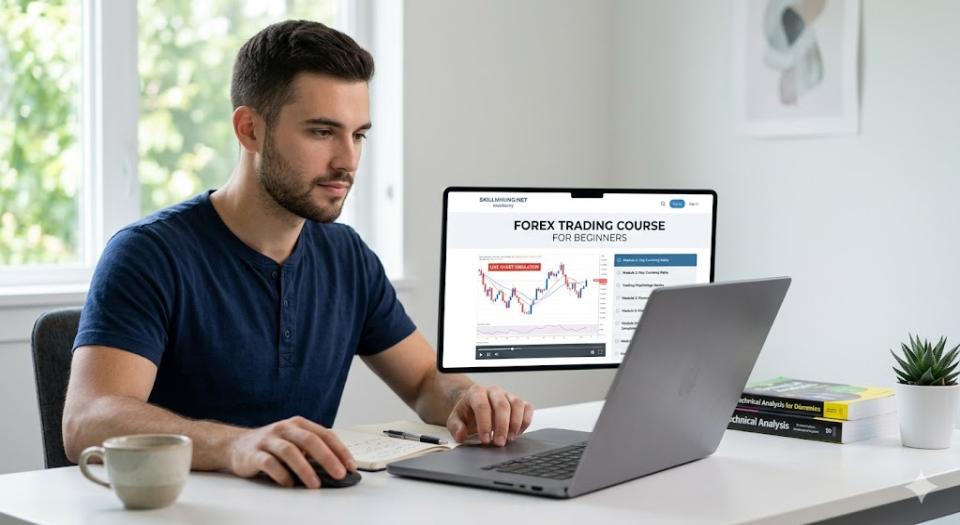
Whether you want to generate a side income or turn trading into a full-time career, taking that first step can feel overwhelming. That’s exactly why we built the Forex Trading Course at Skillmining.Net—to cut through the noise and give you a clear, structured path to success.
In this guide, we’ll break down the absolute basics of Forex trading so you can start your journey on solid ground.
What is Forex Trading?
Forex trading is the act of buying one currency while simultaneously selling another. The goal is simple: to profit from changes in the exchange rate between those two currencies.
Unlike the stock market, which revolves around centralized exchanges like the NYSE, Forex is decentralized. It operates 24 hours a day, five days a week, through a global network of banks, institutions, and individual traders.
How Currency Pairs Work
Currencies are always traded in pairs. When you look at a Forex quote, you will see two currencies listed together.
The Base Currency: The first currency in the pair (e.g., EUR in EUR/USD). This is the currency you are buying or selling.
The Quote Currency: The second currency in the pair (e.g., USD). This tells you how much of the quote currency is needed to buy one unit of the base currency.
If you believe the Euro will strengthen against the US Dollar, you would buy the EUR/USD pair. If you think the Euro will weaken, you would sell (or short) it.
Key Forex Terms You Must Know
Before you place your first trade, you need to speak the language. Here are the core concepts:
Pip (Percentage in Point): The smallest unit of price movement in a currency pair. For most pairs, a pip is the fourth decimal place (e.g., if EUR/USD moves from 1.1050 to 1.1051, that is a one-pip movement).
Lot Size: How much currency you are buying. A standard lot is 100,000 units of the base currency, but beginners usually trade in "mini" (10,000) or "micro" (1,000) lots to manage risk.
Spread: The difference between the "bid" (sell) price and the "ask" (buy) price. This difference is how brokers make their money.
Leverage: Borrowing capital from your broker to open larger positions than your account balance would normally allow.
The Double-Edged Sword of Leverage
Leverage is the most important—and dangerous—concept for a beginner to grasp. A 1:50 leverage means that for every $1 in your account, you can control $50 in the market.
While leverage can magnify your profits, it equally magnifies your losses. Try out this interactive simulator to see exactly how leverage and pip movements affect a trade:
5 Steps to Start Trading Forex
Ready to jump in? Here is the step-by-step roadmap for beginners:
Educate Yourself Thoroughly: Trading without education is just gambling. Enroll in a structured program like the Forex Trading Course at Skillmining.Net to learn fundamental analysis, technical charting, and trading psychology.
Open a Demo Account: Never risk real money until you know what you are doing. Most brokers offer free demo accounts funded with "paper money." Practice executing trades, setting stop-losses, and reading charts.
Develop a Trading Strategy: Decide what kind of trader you are. Are you a day trader who opens and closes positions within a few hours? Or a swing trader who holds positions for days or weeks? Stick to one strategy and backtest it on your demo account.
Start Small with Real Money: Once you are consistently profitable on your demo account, transition to a live account. Start with micro-lots so that inevitable beginner mistakes don't wipe out your capital.
Keep a Trading Journal: Document every single trade you make. Note your entry price, exit price, why you took the trade, and how you felt. Reviewing this data is how you identify mistakes and improve over time.
The Golden Rule: Risk Management
The most successful traders aren't the ones who make the most money on a single trade; they are the ones who survive the longest.
Never risk more than 1-2% of your total account balance on a single trade.
Always use a Stop-Loss order. This automatically closes your position if the market moves against you by a certain amount, preventing catastrophic losses.
Keep your emotions in check. Revenge trading (trying to immediately win back a loss) is the fastest way to blow up an account.
Take the Next Step with Skillmining.Net
Forex trading offers incredible freedom and financial potential, but it requires patience, discipline, and the right mentorship.
You don't have to figure it out alone. Skillmining.Net offers a comprehensive, step-by-step Forex Trading Course designed specifically for beginners. We walk you through how to read price action, manage your risk, and build a trading system that actually works.